济南济柴环能燃气发电设备有限公司
—— 燃料发电设备及机组相关配套设备及配件 ——
—— 燃料发电设备及机组相关配套设备及配件 ——
 全国服务热线:

全国服务热线:
 济南济柴环能燃气发电设备有限公司
联系电话:罗总18653152416
服务热线:0531-62325028
联系地址:中国(山东)自由贸易试验区济南片区孙村街道经十东路33688号章锦综合保税区联东U谷科创中心5号楼101
在可再生能源家族中,生物质气发电机组以其独特的“变废为宝”能力而备受关注。它将农林业废弃物、生活有机垃圾等低热值固体生物质资源,通过气化转换为可燃气体,再驱动发电机组产生电能。这种技术路线既能解决可再生能源的有效利用问题,又能解决各种有机废弃物的环境污染问题。
In the renewable energy family, biomass gas generators are highly regarded for their unique ability to turn waste into treasure. It converts low calorific value solid biomass resources such as agricultural and forestry waste and household organic waste into combustible gas through gasification, and then drives a generator set to generate electricity. This technological approach can solve both the effective utilization of renewable energy and the environmental pollution caused by various organic wastes.
技术原理与系统构成
Technical principles and system composition
生物质气化发电技术的基本原理是把生物质转化为可燃气,再利用可燃气推动燃气发电设备进行发电。这一技术既能克服生物质难于燃用且分布分散的缺点,又能充分发挥燃气发电设备紧凑、污染少的优势。
The basic principle of biomass gasification power generation technology is to convert biomass into combustible gas, and then use the combustible gas to drive gas-fired power generation equipment for power generation. This technology can overcome the disadvantages of difficult combustion and dispersed distribution of biomass, while fully leveraging the advantages of compact and less polluting gas-fired power generation equipment.
一套完整的生物质气化内燃发电系统主要由三大部分组成:气化炉、燃气净化系统和内燃发电机组。气化炉是将生物质由固态转化为燃气的核心装置——生物质在气化炉内通过控制空气供应量进行不完全燃烧,生成包含氢气(H?)、一氧化碳(CO)、甲烷(CH?)等可燃成分的燃气。气化产生的燃气出口温度随气化炉型式的不同在350℃至650℃之间,且含有未完全裂解的焦油及灰尘等杂质。为满足内燃机长期可靠工作的要求,需要对燃气进行冷却和净化处理,使燃气温度降到40℃以下、焦油灰尘含量控制在50mg/Nm?以内。净化后的燃气再进入内燃机,混合空气燃烧做功,驱动发电机进行发电。
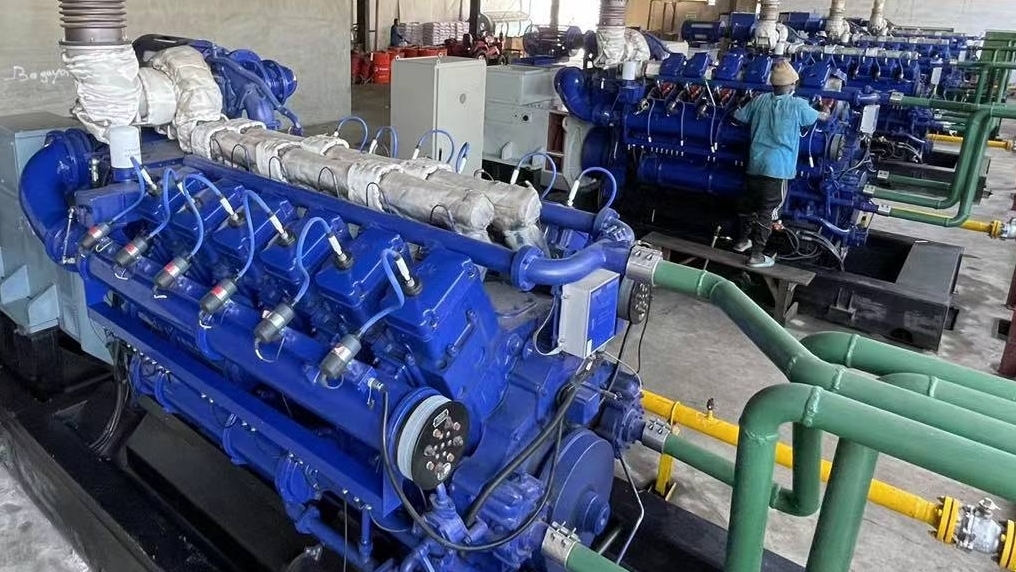
A complete biomass gasification internal combustion power generation system mainly consists of three parts: gasifier, gas purification system, and internal combustion generator set. A gasifier is a core device that converts biomass from solid to gas. Biomass is incompletely burned in the gasifier by controlling the air supply, producing gas containing combustible components such as hydrogen (H?), carbon monoxide (CO), and methane (CH?). The outlet temperature of the gas generated by gasification varies between 350 ℃ and 650 ℃ depending on the type of gasifier, and contains impurities such as incompletely cracked tar and dust. To meet the long-term reliable operation requirements of internal combustion engines, it is necessary to cool and purify the gas to reduce the gas temperature to below 40 ℃ and control the tar and dust content at 50mg/Nm? Within. The purified gas then enters the internal combustion engine, mixes with air to burn and do work, driving the generator to generate electricity.
生物质气化发电可通过三种途径实现:生物质气化产生燃气直接进入燃气锅炉生产蒸汽再驱动蒸汽轮机发电;将净化后的燃气送给燃气轮机燃烧发电;或将净化后的燃气送入内燃机直接发电。在发电和投资规模上,三者分别对应大规模、中等规模和小规模发电。其中,生物质气化内燃发电技术由于装机容量小、布置灵活、投资少、结构紧凑、技术可靠、运行费用低廉、操作维护简单等优势,在商业上得到了最广泛的推广与应用。
Biomass gasification power generation can be achieved through three ways: biomass gasification produces gas that directly enters a gas boiler to produce steam and then drives a steam turbine for power generation; Send the purified gas to a gas turbine for combustion and power generation; Alternatively, the purified gas can be sent to an internal combustion engine for direct power generation. In terms of power generation and investment scale, the three correspond to large-scale, medium scale, and small-scale power generation, respectively. Among them, biomass gasification internal combustion power generation technology has been widely promoted and applied in commerce due to its advantages such as small installed capacity, flexible layout, low investment, compact structure, reliable technology, low operating costs, and simple operation and maintenance.
燃料特性与技术挑战
Fuel characteristics and technical challenges
生物质气发电机组面临的首要挑战在于燃料的复杂性。其燃料源自农业废弃物、畜禽粪便、有机垃圾等,热值波动范围达2000至5000kcal/Nm?,且含有焦油、粉尘等杂质。生物质燃气的特点是热值低(4至6MJ/m?)、杂质含量高,因此生物质燃气发电技术虽然与天然气发电技术的原理一样,但对发电设备的要求有更大的差别。
The primary challenge faced by biomass gas power generation units is the complexity of the fuel. Its fuel comes from agricultural waste, livestock manure, organic waste, etc., with a calorific value fluctuation range of 2000 to 5000 kcal/Nm? And it contains impurities such as tar and dust. The characteristic of biomass gas is low calorific value (4 to 6MJ/m)? )Due to its high impurity content, although the principle of biomass gas power generation technology is the same as that of natural gas power generation technology, there are greater differences in the requirements for power generation equipment.
为保证机组可靠运行,生物质气对进气质量有严格要求:进机燃气温度≤40℃,燃气压力2.5至10kPa,燃气热值≥4.0MJ/Nm?,水分含量≤40g/Nm?且不含游离水,粉尘含量≤30mg/Nm?,粉尘粒度≤5μm,焦油含量≤50mg/Nm?,硫化氢含量≤50mg/Nm?。针对这些要求,先进的生物质气发电机组通常采用非增压自然吸气进气技术,双层管进气系统对焦油的耐受度高,进气阀箱可拆卸设计方便维护保养。
To ensure reliable operation of the unit, biomass gas has strict requirements for inlet quality: inlet gas temperature ≤ 40 ℃, gas pressure 2.5 to 10kPa, gas calorific value ≥ 4.0MJ/Nm? Is the moisture content ≤ 40g/Nm? And it does not contain free water, with a dust content of ≤ 30mg/Nm? Dust particle size ≤ 5 μ m, tar content ≤ 50mg/Nm? Hydrogen sulfide content ≤ 50mg/Nm?. In response to these requirements, advanced biomass gas generators typically adopt non pressurized naturally aspirated air intake technology. The double-layer pipe intake system has high tolerance to tar, and the intake valve box is designed to be detachable for easy maintenance.
应用现状与发展前景
Application Status and Development Prospects
生物质气发电机组的功率覆盖范围较广,从几十千瓦到数百千瓦不等。在燃料来源上,林区的林下废弃物、枝桠材,农业秸秆、棉杆,农场的稻壳,制糖厂的蔗渣,木器加工厂的木屑,城市生活垃圾等均可作为原料。这些废弃物经过相应的生物质气化装置处理后即可用于发电,既有效利用了可再生能源,又保护了环境。在气化发电过程中,内燃发电机的冷却水、气化炉燃气的显热以及发电机组排烟等余热均可回收利用,实现热电联供的综合效益。
The power coverage range of biomass gas power generation units is relatively wide, ranging from tens of kilowatts to hundreds of kilowatts. In terms of fuel sources, understory waste and branch materials from forest areas, agricultural straw and cotton stalks, rice husks from farms, sugarcane bagasse from sugar mills, sawdust from wood processing plants, urban household waste, etc. can all be used as raw materials. These wastes can be used for power generation after being processed by corresponding biomass gasification devices, which effectively utilizes renewable energy and protects the environment. In the process of gasification power generation, the cooling water of the internal combustion generator, the sensible heat of the gasifier gas, and the waste heat from the exhaust of the generator set can all be recovered and utilized, achieving the comprehensive benefits of combined heat and power generation.
生物质气发电机组在海外市场也取得了积进展,已在日本、韩国、泰国、印尼、克罗地亚、罗马尼亚、立陶宛等国家得到广泛应用。随着国家对可再生能源政策的持续支持和生物质气化技术的不断成熟,生物质气发电机组必将在解决有机废弃物污染、促进农村能源结构优化、推动绿色低碳发展等方面发挥更加重要的作用。
Biomass gas generators have also made positive progress in overseas markets and have been widely used in countries such as Japan, South Korea, Thailand, Indonesia, Croatia, Romania, Lithuania, etc. With the continuous support of the country's renewable energy policies and the continuous maturity of biomass gasification technology, biomass gas power generation units will play a more important role in solving organic waste pollution, promoting rural energy structure optimization, and promoting green and low-carbon development.

扫一扫了解更多

扫一扫了解更多